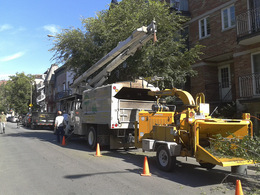
 My second foray into the blogosphere with Montreal's Ecosystems at Your Service. This story is about how resolving a neighbourhood disagreement about whether or not to remove a tree growing beside my apartment building in Montreal. We had an arborist assess the health of our tree and how it could be pruned to reduce potential damage to the building foundation.
I learned a lot about urban trees by researching and writing this story. I didn't know that having trees in neighbourhoods reduces speeding, lowers blood pressure, and increases business revenue. Montreal has some great municipal policies regarding urban trees; I'm really glad that those policies made us have an arborist assess (and save!) ours. My first blog post over at Montreal's Ecosystems at Your Service! I'm really pleased to be part of such a cool project, aiming to connect Montrealers with Nature through story-telling.
Nature and the economy give rise to niches and diversification I like science outreach that uses unusual and creative methods to make their message stick with each audience. The good folks at Minute Earth make short (2-3 minute) YouTube videos explaining all manner of science-y things, from freezer burn to bed bugs, or why some countries drive on the left vs. the right side of the road. This time they tackle niches, competition, and coexistence using the analogy of microbreweries. Here's their basic question: How can little specialist plants (read: microbreweries) survive in a world dominated by big competitive trees (read: macrobreweries)? Here's their answer: "By capturing the most valuable resources before they reach others, dominant trees and companies exclude weaker competitors who employ the same tactics. But there are trade-offs in any strategies, and being the best on average rarely works in all cases and conditions. That's how understorey ferns and microbreweries can succeed, by specialising in conditions the big guys aren't so good at -- the so-called empty niches... Where there are resources, there is the potential to survive. So it's not really surprising that both nature and the economy, driven by the same kinds of competition, give rise to niches and diversification, in the canopy and understorey, in the forest and supermarket aisle." I'll toast to that! And with some great organic microbreweries and wineries to boot! |
AuthorConservation scientist at the Yellowstone to Yukon Conservation Initiative (Y2Y). Likes trees, mountains, chocolate, and looking under rocks. Feminist. Archives
March 2020
Categories
All
|

 RSS Feed
